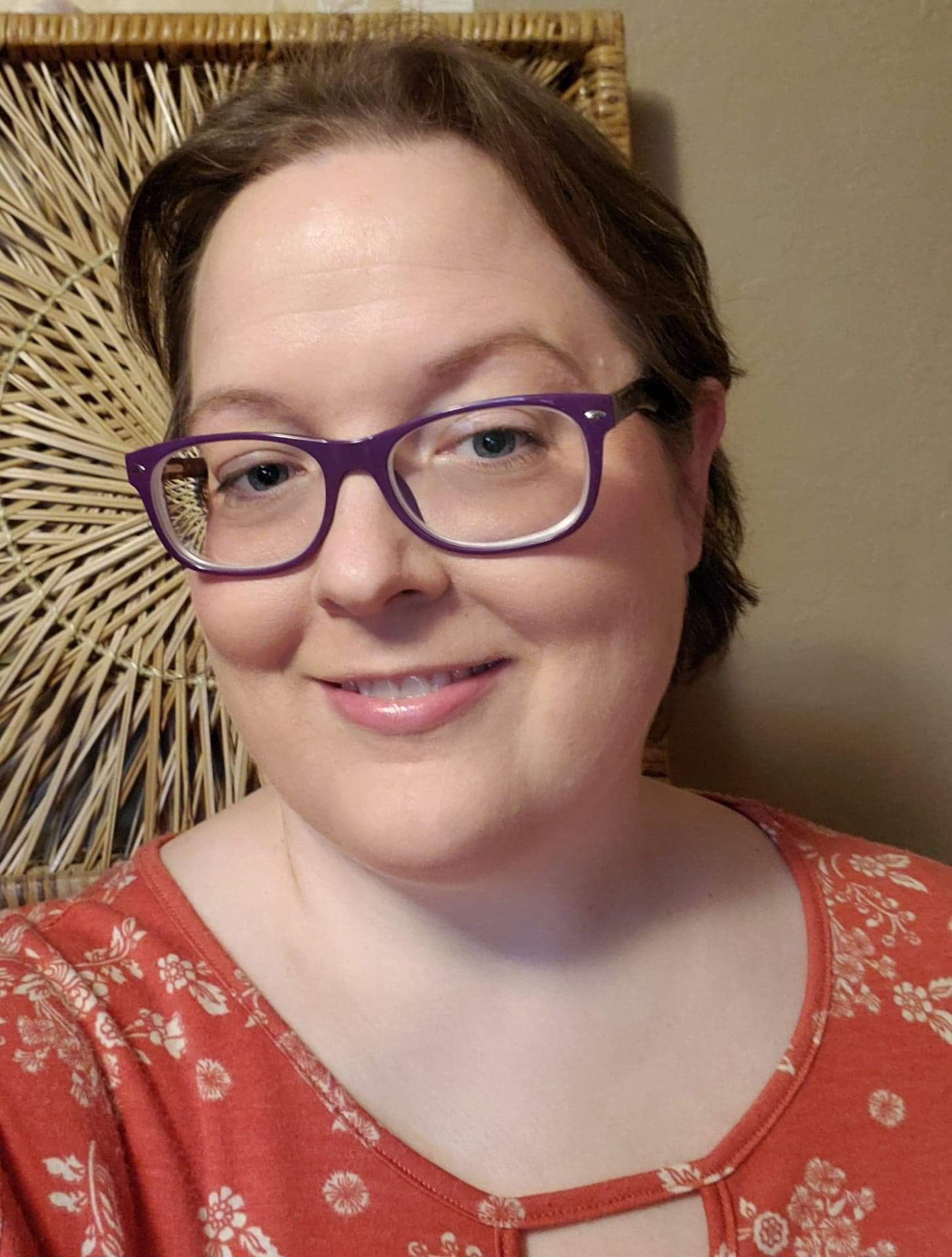
Mae Thorn is the author of several historical fiction and romance novels, including Poisonous Passions, Briarwyck, Wyvern, and an upcoming #OwnVoices novel Without Words. The manuscripts are currently pending homes and are out on submission. Diagnosed with Treft Syndrome, a rare genetic mutation that causes vision, hearing, and balance difficulties, Thorn identifies as hard of hearing.
In today’s post, we talk about the importance of never giving up on writing, the fascinating genres included in speculative fiction, and actually finishing a novel during NaNoWriMo.
Recently on your blog, you talked about perseverance and how that was the key to writing your books. Can you give the readers ideas about how to persevere in their own craft?
Perseverance is an everyday practice. You have to get up every morning and do at least one thing to hit your goal. Of course, I did skip days. I had a big mental block last fall, and I found that working through it was the only solution. It takes a lot of baby steps to make a mile.
2. Without Words is an #ownvoices romance and fantasy novel. How does the main character reflect your own journey with accepting hearing loss?
Without Words is very much my story. It goes through the same stages I went through before I accepted my hearing loss. I’ve heard that when you lose your hearing, you go through the stages of grief. Denial, anger, bargaining, depression, and acceptance. My denial lasted the longest. I wrote it as a kind of therapy and venting exercise. My agent is currently looking for a home for Without Words.
3. Your other writings delve into everything from sci-fi, nonfiction, horror, and fantasy. What books and authors inspired your writing style growing up?
I’m a big fan of Jane Austen, and she has inspired my historical romance novels (also waiting for a home). The Mayfair Witches from Anne Rice has also inspired me. Without Words is about witches. I would be remiss if I didn’t mention one of my earliest inspirations, The Hobbit and The Lord of the Rings trilogy. I started writing fantasy shortly after reading Tolkien when I was about 14. Also, I used to read a lot of poetry too. William Blake, Emily Dickinson, and Edgar Allan Poe were some of my favorites.
4. What is some advice you would give to those who want to participate in NaNoWriMo? What kinds of goals do you set during the month?
NaNoWriMo or National Novel Writing Month gives you the goal of writing 50k words in a month, which is basically a short novel. Whether you accomplish the goal or not, it is a good motivator. My best advice is to not look back. Don’t edit and don’t stop. Write every day if you can.
5.What other work do you have planned?
Without Words is meant to be a series following each witch I mention. In the second book, I will tackle my depression and anxiety, which will be a difficult task since I’m still learning to cope with it. Right now, I’m editing my historical romance series to prepare it for publication. It’s a lot of work, but I’m loving it. Being a writer is an ideal job for someone with my disabilities because it gives me the freedom to manage my own time and have my own communication style.
Author Tamara Kaye Sellman | Photo by Elizabeth Thorpe
Tamara Kaye Sellman is an author, advocate, and curator of sleep-wellness content. But that just scratches the surface of everything Sellman has accomplished in her life. Her new book Intention Tremor chronicles five years of her experience with multiple sclerosis (MS) with both poetry and nonfiction. Besides releasing a book during a pandemic, Sellman kindly chatted with me about art, advocacy, and everything in between.
1. Your new book Intention Tremor is a hybrid work of creative nonfiction and poetry. How does the hybrid nature of the book convey your message? It does two things, really. I’m a cross-genre, cross-form writer (which means I write poetry, fiction, and nonfiction, and inside those forms, I write in different genres). To write something as intimate as a medical memoir meant I needed to be authentic, and hybrid is the most authentic way I express myself. I am one of those people who has an idea and then let’s the idea choose its form (at least in my creative writing life). So some things I write live in the prose poetry space, others are formal poetry, still others are fragmented essays or brief traditional creative nonfiction forms.
For me to try to pigeonhole every piece in this book to meet a singular formal demand would be, in a way, a kind of lie. That’s not how my mind works, and it made no sense for me to give up that part of my identity to cleave to only poetry or only prose in a collection that’s so personal.
The eclectic nature of hybrids also makes for a fitting metaphor of how the brain works when you have a neurological condition. Brains use neural networks to convey signals, and when there are blocks, these signals are either delayed or aren’t delivered or received at all. Or, if you’re lucky, your brain finds alternate routes (this is what neuroplasticity is all about). So from a sense of form, a book written about a broken brain probably shouldn’t be a neat and tidy one-form expression.
2. When did you first start writing? How has your writing evolved? I wrote my first original sentence on a chalkboard in colored chalk in preschool in 1969. I wrote a lot as a child, reams of penmanship—then notebook—paper created firetraps in my closet (I drew a lot, too). I only used a typewriter in high school for homework, so I used journals and diaries then until I landed my Commodore 64 in the 1980s. Then it was off to the races.
I pursued journalism in college (with a brief spell in creative writing as a minor) so that I could solidify a writing career path. And that’s mostly been my reality: I’ve worked as an editor, publisher, freelance writer, columnist, and writing coach for most of my adult life (my first job in the mid 1980s).
I had always thought I would put off my creative writing until retirement but then I had children and realized that I needed a writing life to be a whole person. I wanted also for my daughters to see I was pursuing something that fed my soul.
In 2012-2013, I went back to school to earn medical credentials in sleep technology and certified sleep health education. My original plan had always been to pursue more science journalism. Having these medical credentials has definitely given me a leg up on that competition. At about the same time, I was diagnosed with MS. While I worked in a lab for 2 years, having MS forced the decision to leave patient-facing shift work, which is not at all agreeable with even the healthiest brains.
Today, I write columns, articles, and posts for various illness communities, specializing in sleep disorders and fatigue. I also write continuing education learning modules in a multimedia format, so I’m still writing and still using my medical credentials in spite of having MS. I also write about MS in a chameleon sort of way: I share my lived experience, but I also write about the disease itself, or news and developments in research, and I write book reviews whenever I can.
I feel I’m now living my best life, the one I decided was right for me at the ripe old age of five years-old.
Intention Tremor: A Hybrid Collection by Tamara Kaye Sellman
3. What has it been like hosting a virtual book tour due to the pandemic? What have been some surprising perks or downsides you’ve faced because of the format? It’s really hard. Partly the loss of live events is an emotional blow, as this is my debut book and I have envisioned the dream author party and live readings as part of the celebration of that journey. The pandemic has stolen this from new writers launching books at this time.
I have always prided myself on being an early adopter of new technologies. And that has been the case until these last few years. When MS started messing with my organizational mind, I had to step back a little. There is a kind of overwhelm you get as a person with neurological obstacles—not really a sensory overload, but a screen/technology overload—and the only way around it is to just turn off the computer.
Meanwhile, the pandemic has forced all literary events to the Internet. Plus side: people from all around the world can come to your event. Minus side: all that screen/technology overload is a risky pursuit. I’m dealing with a surge of symptoms that are primarily cognitive that are probably triggered by too much screen time. I also face issues with reading and speech which are magnified in a virtual setting.
I find it easier—but sometimes exhausting—to read live in front of people because at least I can look them in the eyes as I read. Now the only eye I look into is the eyeball-shaped camera on top of my laptop. The book signing line at a live event is a great place to have brief, energizing conversations privately with people who buy your book. After an online reading, there isn’t a chance for these intimate encounters unless they’re done in chat, and that’s not really very intimate, either. And you just don’t sell as many books.
I hope that there will be a hybrid approach to readings after the pandemic is over. I have enjoyed interacting with others in my readings who were never going to go to my readings before because of limitations in geography or physical ability. But I can’t wait to throw some back yard parties in the near future where I can sell my books much more easily without a middleman. And maybe the local booksellers will cut debut writers some slack and welcome them into the fold when it is safe again, even if their pub dates have come and gone. It wasn’t our fault the timing was so bad.
4. How does art empower you? It allows me to own my space in a way that is public, beautiful, and honest. It also gives me tools for articulating my disease, and art connects me with others with similar struggles and interests.
5. What do you wish people understood about MS? They call it the “snowflake disease” because no two cases are alike. I wish people understood that some people end up in wheelchairs with no cognitive dysfunction, while others can walk just fine but struggle with cognitive dysfunction. There are lots of invisible symptoms too. Among mine are chronic tinnitus, IBS, migraines, paresthesia, tremor, muscle weakness, paralyzing spasms of the muscles (especially around my rib cage), and chronic pain. We treat MS with a medication that *maybe* slows down the progression, and we treat symptoms individually. It ends up being a lot of pills and/or shots and/or chemo with side effects. It’s a really complex disorder and that is part of the reason why we don’t have a cure or even a conclusive understanding of what causes it.
All of my proceeds from Intention Tremor‘s sales benefit the Accelerated Cure Project, so sales are a big reason I do any of this. The ACP is there to help MS researchers restart and reclaim their momentum, which has died off (by necessity) because of COVID-19. We need a cure and we need better treatments for our more severely affected members of the MS community. Two hundred new cases of MS are diagnosed every week, pandemic or not. People need help.
Interested in seeing more of Tamara’s work? Follow her through the links below:
After writing a piece for Next Avenueabout the power of artistic expression in the disabled community, I’ve been wanting to have more conversations similar to the ones I had with the artists at the Interact Center for Visual and Performing Arts. So why not do it?
I’m launching a new interview series on my blog to include perspectives of disabled artists from all backgrounds. Visible and “invisible” disabilities, those who use identity-first or person-first language, full-time or part-time creators, all are welcome. BIPOC and LGBTQ+ voices are strongly encouraged to participate!
how do i participate?
Here’s the deal:
Using the contact form or emailing me directly at gales.gretchen@gmail.com, let me know the following:
Some background about who you are, the name of your disability should you wish to disclose it, if you prefer identity-first or person-first language, and your mode of creative expression (painter, writer, graphic designer, etc.).
A headshot or a picture of your visual work to include in the interview.
Links to websites, social media, blogs, or other places to learn more about you.
Any other information that may be relevant.
All interviews will occur over email unless we arrange the interview in some other form.
Unfortunately, I cannot afford to pay participants. You are welcome, however, to include links to your Venmo, Cash App, Ko-Fi, or other apps to spread the word about how people can support your work. This also includes links to online stores or social media.
If any accommodations are necessary, please let me know. I’m working on making the blog as accessible as possible and hope to make it more user-friendly for everyone in the future.
Don’t worry if I don’t reach out right away! More than likely I just have a backlog of interested participants or a backlog of emails in general. Please be patient.
Send any additional questions through the same contact form!
I look forward to creating another outlet for activism and expression!
As an English and history double major, storytelling is a major part of my life and the inspiration behind a lot of my writing. I also love incorporating these stories into my teaching whenever possible, and more than ever, our students need hope and strength.
Looking to incorporate women’s stories that encourage students into your curriculum? These three stories can be used to inspire students across all secondary classrooms just in time for Women’s History Month in March and beyond.
For a story about standing up for what is right, no matter the cost, tell the story of Sophie Scholl and The White Rose. The White Rose was an underground resistance movement whose mission was to spread information about the heinous truths of Nazi Germany through informational leaflets. Each leaflet called fellow Germans to do what was moral and just. Unfortunately, all members were caught and executed for their peaceful resistance, but their words still inspire activists and people across the globe.
Several books and films have been released about the story, including one by Sophie’s sister Inge Scholl. Plough Publishing House recently released a graphic novel version called Freiheit! The White Rose Graphic Novel by Andrea Grosso Ciponte, so it can be the perfect addition to your classroom library.
From 1943 to 1970, the Langley Memorial Aeronautical Laboratory in Hampton, Virginia inspired women to pursue careers in STEM and were pioneers of NASA’s early projects. Dubbed as “human computers”, the most recognizable names are Dorothy Vaughan, Mary Jackson, Katherine Johnson and Christine Darden. Their story, told by Margot Lee Shetterly’s 2016 book Hidden Figures, inspired many Black girls and women to pursue STEM careers.
While the movie is also a wonderful teaching tool, the young adult adapted version of the book gives another accessible way to learn the story of the four women. Students may also look into Shetterly’s Human Computer Project dedicated to recording the histories of the women who made space exploration possible.
Malala Yousafzai stunned the world when she was attacked by the Taliban and lived. But her fight for a girl’s right to an education is living women’s history. Not only is she the youngest recipient of the Nobel Peace Prize, she has written several bestselling books about her story that continue to inspire girls and women everywhere.
Whether you are having your child learn from home through Zoom or braving the world of homeschooling, fostering a love of reading and writing in them can be difficult. Without previous training in education or in English Language Arts instruction, many parents find themselves confused and frustrated. But don’t give up yet! I’ve put together 4 simple ways to help you teach English Language Arts from the comfort of your home along with sharable graphics to show your fellow homeschool friends.
This method is used by many ELA teachers in order to develop students’ writing. The only way to get better at writing is to write! Give them a choice of prompts, but don’t be afraid to challenge them with hard topics, too. Kids can surprise us with how insightful they can be when given the chance to express themselves.
That doesn’t mean it will go well the first time or even within a few weeks. Writing and being willing to write is a skill that needs to be developed over time. Let your student have days where they can write on any topic they would like and add pictures to illustrate their prompt.
2. Have them read a book of their choice for 25 to 30 minutes.
Reading for 25 to 30 minutes a day can drastically improve reading comprehension. But the key is to let them read what interests them, whether it is a typical book or graphic novel. They can also read short sets of articles.
To find books for low to no cost, consider taking your child on a trip to a local thrift store, discount book store, or the local library. You can also download apps such as Overdrive or Libby, which both connect to your local library system, to check out e-books from the comfort of your home.
Listening comprehension is equally as important as reading and writing comprehension and helps to engage reluctant learners. Like books, there are podcasts and audiobooks on a variety of topics your child can choose from and enjoy.
Subscription services such as Audible are great for audiobook options, but for cost-free options, consider downloading OverDrive, which in addition to regular e-books also have audiobooks to borrow for free to any device.
For podcasts, browse various streaming services or download podcast apps such as Castbox to find appropriate titles for your child. Some focus on a broad topic such as sports or true crime while others may be more focused and in a storytelling format.
One of the biggest pitfalls that parents fall for is to never let a child struggle with an answer or not give them space to work through a problem by themselves. This can lead to a heavy level of dependence and more difficulties in their learning journey down the road.
This isn’t to say let them struggle all of the time, of course. It can be hard to let kids struggle, but if they don’t immediately know the answer, encourage them to think it through or do some research. This helps build critical thinking and problem-solving skills.
Want bite-sized, shareable tips for teaching English Language Arts? Check out the graphics I designed based off of this piece:
Still need guidance?Reach out to me for consultations or virtual tutoring services or consultations.
The Secret Life of Bees is a favorite among book clubs and English classes for its themes of motherhood, spirituality, and racial tension during the Civil Rights Era. But the book also addresses problems we still see today: hidden biases.
Though Lily, the fourteen year-old white protagonist, has grown up with her black mother-figure Rosaleen and is considerably kinder to her than her father T. Ray, she still falls victim to the thinking of her time. When she meets August, one of the three beekeeper sisters that Lily and Rosaleen find in Tiburon, SC, she is shocked to discover that August is in fact, very intelligent and well-read.
It was 1942. Sophie Scholl was a student at the University of Munich when Adolf Hitler brought Germany to ruin. She, like most Germans, was optimistic about Hitler’s leadership, clinging to him to lead the nation out of a horrendous economic collapse and international scorn left over from the First World War. She joined the Hitler Youth as many German teens did. Though as the war progressed, there were signs that Hitler was not a savior of the German states. Her brother Hans briefly served on the front lines and witnessed the horrific treatment of those considered inferior to Hitler’s standards, confirming their father’s suspicions of Hitler’s insidious intentions.Sophie, Hans, friends, and their psychology/philosophy professor formed Die Weiβe Rose, or The White Rose, an intellectually based, peaceful resistance movement against Hitler’s regime. Their campaign consisted of essays written as leaflets and distributed anonymously throughout the region.
The first leaflet appeared around the University of Munich. The leaflet criticized and called for Germans to stand against the tyranny of Hitler, criticizing the actions that Hitler had taken during the war. The leaflet references concentration camps and correctly predicts the outcome of the German legacy immediately following the war:
It is certain today every honest German is ashamed of his government. Who among us has any conception of the dimensions of shame that will befall us and our children when one day the veil has fallen from our eyes and the most horrible of crimes – crimes that indefinitely outdistance every human measure – reach the light of day?
The words were shocking, and the first instance of blatant backlash against Hitler’s authority. The Gestapo were baffled as copies of the leaflets began showing up in the mail. Students at the University of Hamburg also began joining in the efforts, copying and mailing out more leaflets across Germany. The leaflets were left outside of lecture halls so that students would see them as they walked out of class along with telephone booths and on the ground. The White Rose exhibited true nationalism, reminding the public of the glory that Germans once had. Besides the obvious objective of resisting fascism and Hitler, the leaflets were also aimed towards reviving the cultural and intellectual pride in Germany, often quoting Goethe (the “German Shakespeare”) among other significant German figures. The leaflet refers to Goethe’s views of Germans as a “tragic people,” but then goes on to describe then modern Germans as “spineless [and a] herd of hangers-on.” Sophie was a devout Lutheran, and other members of The White Rose were also particularly pious. Many Germans had ties with Catholicism and Lutheranism, and Sophie’s boldness was heavily driven by her faith. Prior to her death, Sophie often laced her urgent conversations with family with optimistic valor. Her speech, like the wording in the leaflets, was highly descriptive and poetic, incorporating wisdom in her words:
“Only man can be truly ugly, because he has the free will to estrange himself from this song of praise. It often seems that he’ll manage to drown out this hymn with his cannon thunder, curses and blasphemy. But during this past spring it has dawned upon me that he won’t be able to do this. And so I want to try and throw myself on the side of the victor.”
The faith of all of the members appeared in their arguments against the soulless regime, comparing their fellow Germans to nothing more than will-less animals:
If the German people are already so corrupted and spiritually crushed that they do not raise a hand, frivolously trusting in a questionable faith in lawful order in history; if they surrender man’s highest principle, that which raises him above all other God’s creatures, his free will; if they will abandon the will to take decisive action and turn the wheel of history and thus subject it to their own rational decision; if they are so devoid of all individuality, have already gone so far along the road toward turning into a spiritless and cowardly mass – then yes, they deserve their downfall.
As conditions worsened, more leaflets were hastily distributed. Unfortunately, Sophie, Hans, and friend Christoph Probst were arrested in 1943 after a janitor at the university witnessed Sophie throwing the leaflets from the second floor of the atrium. On February 22nd, 1943, Sophie Scholl, Hans Scholl, and Christoph Probst were executed by guillotine. After their execution, copies of the final leaflet were copied and dropped from planes all across Europe.
Sophie’s sister Inge wrote the story of her siblings’ movement in her book The White Rose. In 2005, the story snagged the Academy Award for Best Foreign Film in Sophie Scholl – The Final Days.
Sophie’s acts are now considered courageous throughout Germany and the University of Munich has a square dedicated to The White Rose. Many would think that Sophie is an extraordinary woman. And she is. But what is so extraordinary is that a typical young woman dared to make a change.
In today’s time, “ordinary” women such as Malala Yousafzai have stepped up to fight for their own causes. I have heard plenty express their ideas and desires for a better future, but never take initiative because they believe they are “too young.” But the only requirement is to take initiative, no matter when, what, or how old you are, and start a movement…just as Sophie told the court while deciding her fate:
“Somebody, after all, had to make a start. What we wrote and said is also believed by many others. They just don’t dare express themselves as we did.”